.jpg)
Reducing Biogas Losses to Improve Safety, Efficiency and Sustainability
Industry News
Sustainability
While AD plants are designed to provide renewable energy, ongoing optimisation and expert management are essential to maximise their environmental and operational performance. Methane leakage remains a significant challenge, increasing greenhouse gas (GHG) emissions while also creating safety risks and impacting process efficiency.
Measuring escaping emissions can be difficult, as they often originate from parts of the process that are not routinely monitored or controlled. However, emerging technologies are helping operators identify emission sources more effectively, creating new opportunities to optimise performance and reduce environmental impact.
Alpheus is gaining first-hand experience of the potential these technologies can offer, from extending the life of critical biogas assets through long-term methane monitoring to supporting innovative approaches for recovering residual methane from digestate.
Methane leakage isn't just an environmental issue; it reduces energy output and creates potential safety risks.
As a highly flammable gas, methane can create explosive atmospheres during the handling, storage and transfer of sludge, while escaping biogas represents lost revenue and a missed opportunity to generate heat and electricity. Capturing and retaining this gas improves safety, increases energy recovery and enhances overall site performance.
Leakage tends to occur at specific points such as digester roofs, seals, and vents, or due to random equipment failures. Open-topped vessels and storage lagoons for digestate are designed to allow for dissipation of residual methane and the associated explosion risk, but are a major source of methane losses.
Monitoring the escaping methane is necessary to maintain plant stability and ensure that equipment, such as gas upgrade units and CHP engines, operate efficiently.
There are two approaches to measuring gas emissions – either looking at an entire geographic area, or looking at a specific point in the process.
Using these techniques, a large body of academic research has revealed significant methane losses across the entire biogas sector, with some process activities, such as tank filling, emerging as a particularly high source of emissions.
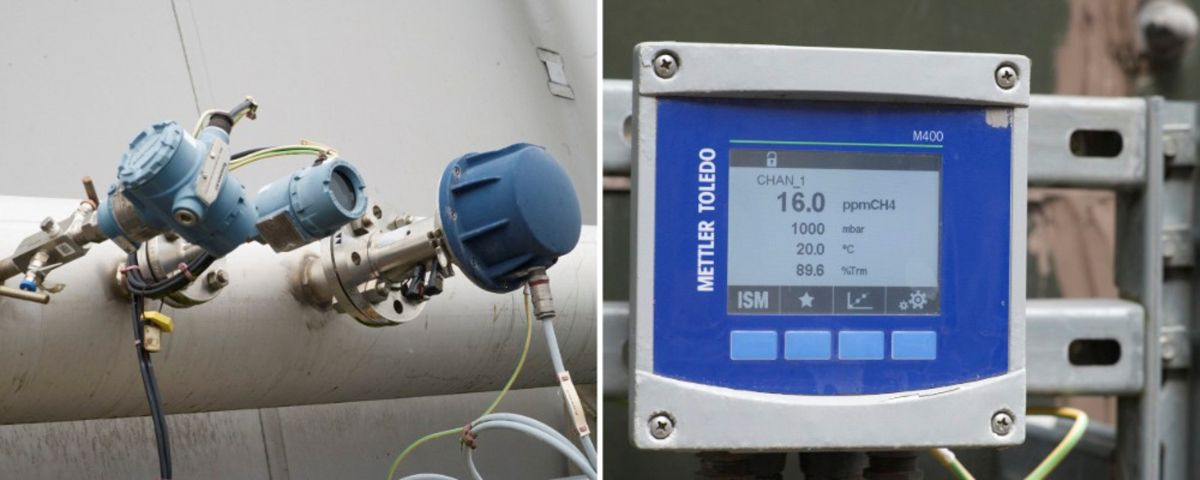
Continuous methane monitoring helped a Scottish pharmaceutical site more than double the service life of a membrane gas holder, avoiding years of premature capital expenditure.
At this biogas facility, Alpheus transformed a relatively small investment into a significant commercial return. By applying innovative monitoring technology to an existing asset, the site gained the confidence to maximise membrane life while maintaining safety and compliance.
AD plant membranes in chemical environments often deteriorate faster than suppliers expect, solvents, sulphides and ammonia can stiffen or chemically attack the membrane, creating microscopic tears that weaken integrity. Because membrane condition cannot be reliably assessed through visual inspection alone, the challenge was establishing a way to determine the actual membrane health.
Working in partnership with Mettler Toledo, we repurposed a Tunable Diode Laser (TDL) analyser to measure methane permeation through the membrane at parts-per-billion levels. The novel application provided unprecedented visibility into membrane condition, delivering insights that conventional inspection methods could not.
Installed in 2020, the analyser provided continuous, real-time monitoring of membrane performance. The resulting data gave operators the confidence to safely extend the asset's operational life to 13 years, more than double the manufacturer's recommended six-year lifespan.
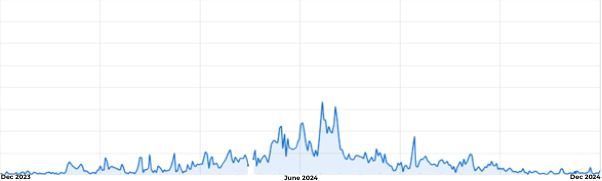
Understanding membrane health requires more than a single snapshot in time. Factors including temperature, operating pressure and gas volume all influence methane permeation rates. Continuous monitoring enabled trends to be tracked over the long term, helping operators distinguish normal variation from genuine deterioration and make informed maintenance and replacement decisions.
The graph below illustrates methane emissions over a 12-month period. Emissions increase during warmer weather before returning to baseline levels, demonstrating why continuous monitoring provides a far more accurate assessment of membrane condition than periodic inspections or spot checks.
After 13 years of service, the site elected to replace the membrane. By using objective condition data rather than relying solely on manufacturer assumptions, the asset remained in operation for significantly longer than originally anticipated, delivering substantial lifetime capital savings.
A modest investment in monitoring delivered seven additional years of service life, deferred replacement costs and measurable long-term value. That's the power of turning data into smarter asset decisions.
Since privatisation of the municipal wastewater sector in England, anaerobic digestion has become a key process, reducing the amount of sludge that requires disposal and allowing the recovery of energy.
One of the issues that has resulted from this technology change is the need for digestate storage. The process safety risks that come from the formation of explosive atmospheres associated with digestate storage were tragically illustrated at the Wessex Water Avonmouth explosion in December 2020.
While details are still somewhat unclear, what is known is that methane had collected in the headspace of a vessel that contained digested sludge, and that a fugitive emission was ignited, resulting in four deaths.
If methane had been removed from the sludge and the sludge had been deactivated before storage, the incident would not have occurred in the way it did. Alpheus have been supporting Anglian Water and Bluemethane to operate a trial of technology that aims to capture and reduce methane emissions from post-digested sludge. If successful, this solution would also deliver soft benefits of increased biogas output and lower GHG emissions.
As Principal Designer (PD) and Principal Contractor (PC), our team has been responsible for the site installation, integration of the pilot plant, and will also manage operations throughout the trial.
As methane emissions come under increasing scrutiny, operators are facing growing expectations around monitoring, measurement and reporting. While current UK sustainability reporting requirements do not capture all emission sources, future regulation is likely to place greater emphasis on understanding and reducing methane losses.
For AD operators, having robust monitoring and management processes in place will be increasingly important to demonstrate good environmental performance, support compliance, and meet evolving industry standards.
As the industry continues to focus on improving sustainability, increased monitoring and reducing methane losses offer a clear opportunity to improve safety, increase energy recovery and strengthen environmental performance.
1 "Methodology to Assess Methane Leakage from AD” Part 1 produced for the UK Government Department of BEIS (2016) gives a large range (0-10% of methane produced) for methane emissions from AD. The report suggests that a default value of 5% can be used in the absence of data.